« Back to Pillar Page: Advanced Product Discovery with AI
7 Agile Product Discovery Workshop Activities to Validate Ideas Faster (2026)
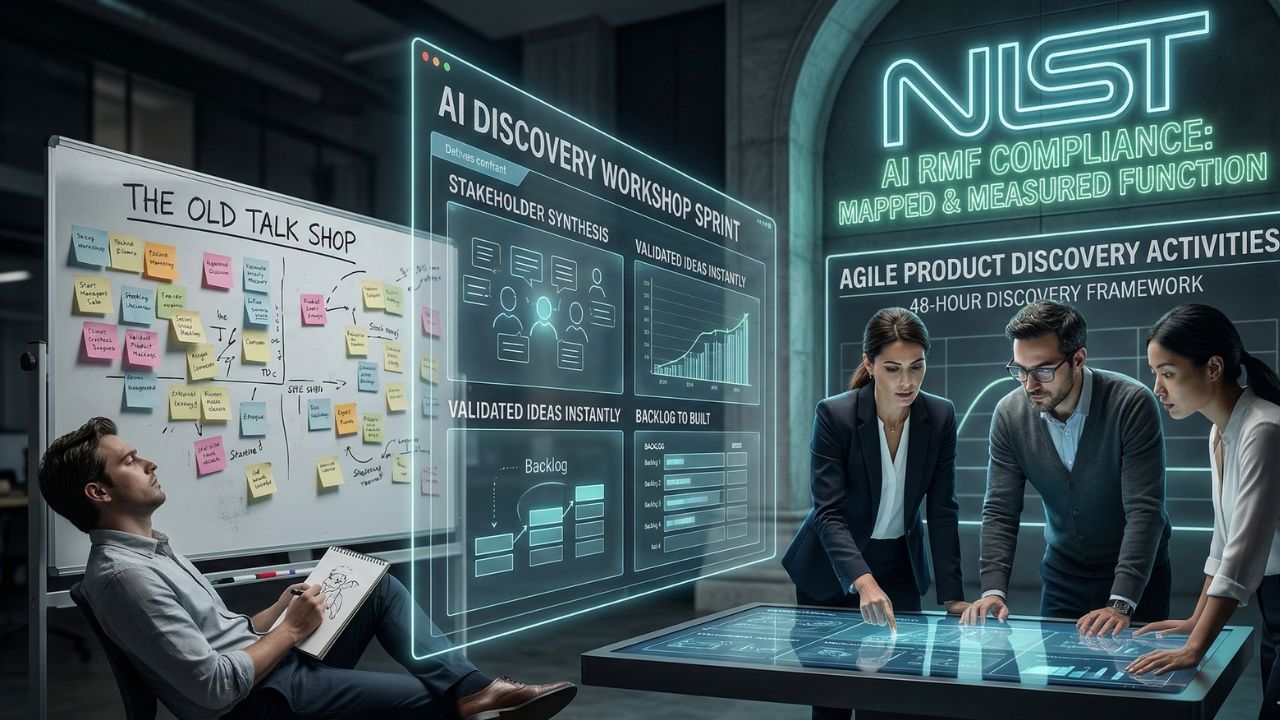
What's New in This Update
- AI Facilitation Frameworks: Added modern techniques using LLMs to bypass manual post-it sorting.
- NIST Compliance: New discovery activities specifically mapped to the latest NIST AI RMF requirements for enterprise products.
- Remote Tool Templates: Updated guidance for running these sessions synchronously via Miro and Mural.
- Stop endless meetings: Discover 7 data-driven agile product discovery workshop activities to align stakeholders instantly.
- Augment with AI: Use generative tools to cluster ideas, build synthetic focus groups, and remove cognitive bias from ideation.
- Map compliance early: Integrate the NIST AI RMF into your discovery phase to avoid catastrophic regulatory bottlenecks before writing code.
- Bridge discovery to delivery: Translate workshop outputs directly into structured, sprint-ready backlogs.
Welcome to the end of unproductive, endless meetings. If your team is spending weeks defining features that users ultimately ignore, your discovery phase is broken. To fix it, you need to execute focused, data-driven agile product discovery workshop activities that cut through corporate noise.
This deep dive expands on the core frameworks taught in our broader guide on Advanced Product Discovery with AI. Historically, product discovery relied heavily on gut feeling and slow user research. Today, successful teams blend human empathy with rapid, machine-assisted validation to map the Double Diamond processin a fraction of the time.
By updating your approach for 2026, you can transition from expensive talk shops to actionable sessions that secure alignment in hours, not days.
Phase 1: Problem Framing & Hypothesis Generation
Before you ideate, you must define the correct problem. Skipping this phase guarantees you will efficiently build the wrong product. We use hypothesis driven developmentto structure our assumptions.
Activity 1: The AI-Assisted Empathy Map
Empathy mapping is a staple design sprint activity, but it frequently suffers from confirmation bias. Stakeholders often invent user pain points that conveniently match the software they already want to build.
The Process: First, ask the team to populate the standard quadrants (Says, Thinks, Does, Feels). Next, take a vast dataset of actual user feedback (Zendesk tickets, app reviews, sales call transcripts) and feed it into a secure LLM.
Prompt the AI to map the real qualitative data against the team's assumptions. The delta between what the room thinks the user feels and what the data proves they feel becomes your prioritized problem space.
Activity 2: Hypothesis-Driven Lean Canvas
Instead of logging features, log assumptions. This workshop activity forces stakeholders to articulate the exact business conditions required for an idea to succeed.
The Process: Break the room into pairs. Give each pair a blank Lean Canvas. Ask them to frame their proposed solution as a testable hypothesis format: "We believe that [building this feature] for [this user] will achieve [this outcome]. We will know we are right when we see [this measurable metric]."
This immediately highlights assumptions lacking success metrics, grounding the workshop in reality rather than opinions.
Phase 2: Ideation & Solutioning
Once the problem is locked in, the goal is volume. Traditional discovery sessions often stall here because the loudest voice in the room dictates the technical direction. Structured activities level the playing field.
Activity 3: Crazy 8s with a Generative Twist
Crazy 8s is a core design sprint exercise where participants sketch eight distinct ideas in eight minutes. It forces the brain past obvious, clichéd solutions.
The Process: Run the standard exercise on paper or a digital whiteboard. However, during the review phase, use an AI image generator or UI wireframing bot (like Google's Stitch) to instantly render the best hand-drawn concepts into mid-fidelity mockups. This allows engineers and business stakeholders to visualize functionality immediately, removing the friction of deciphering bad sketches.
Activity 4: The Synthetic User Focus Group
Waiting three weeks to schedule human focus groups kills product momentum. Instead, simulate the validation layer.
The Process: Use the personas developed in Phase 1 to spin up a synthetic user focus group. Feed the LLM the persona's constraints, budget, and technical literacy. Then, present your newly ideated solutions to the AI agents and ask them to critique the workflow, identify friction points, and predict adoption hurdles. This acts as a rapid "stress test" before you invest in high-fidelity prototyping.
Phase 3: Alignment & Prioritization
Having fifty good ideas is useless if the team cannot agree on which three to build. Prioritization is often where workshops devolve into political battles. By utilizing strict constraints and compliance mapping, you can objectively kill weak ideas.
Activity 5: Buy a Feature (Tokenomics Edition)
This is a classic prioritization game, modernized for AI-heavy roadmaps. When handling difficult stakeholders, this exercise forces them to quantify their demands.
The Process: List the validated ideas from the ideation phase. Assign a "price" to each based on estimated engineering effort and API token costs (a critical factor in 2026 SaaS economics). Give each stakeholder a limited budget of "cash" and force them to buy the features they want most. Because the budget is severely constrained, participants must negotiate and pool resources, organically surfacing the most valuable initiatives.
Activity 6: NIST AI RMF Risk Mapping Matrix
Incorporating compliance early in the ideation phase is non-negotiable for modern products, especially in light of the EU AI Act.
The Process: Create a 2x2 matrix plotting "User Value" against "Compliance Risk." Take your top prioritized features and map them. Specifically, evaluate them against the NIST AI RMF "Map" and "Measure" functions. Does this feature ingest PII? Does it make autonomous decisions affecting human employment? This proactive mapping prevents your team from committing to a feature that will be blocked by legal three months later.
Phase 4: Synthesis & Backlog Creation
A workshop is only as valuable as the work it produces. Leaving an agile product discovery session with a whiteboard full of stickies is a failure; you must leave with a backlog.
Activity 7: Story Slicing & AI Backlog Grooming
Once ideas are validated and prioritized, they must be broken down into sprint-ready work without losing the original context of the workshop.
The Process: Take the top-voted initiative and apply advanced user story slicing techniques. Break the epic down not by technical layers (e.g., "build database," "build UI"), but by thin, vertical slices of user value. Feed these slices into an AI agent configured to format them into standard Jira tickets with strict Acceptance Criteria and "Given/When/Then" testing parameters.
Additionally, mastering backlog management skills for AI productsis essential here to handle complexities like algorithmic model drift and rapid prototype iteration over the ensuing sprints.

Frequently Asked Questions
What activities are done in a product discovery workshop?
Typical sessions involve problem framing, user journey mapping, and ideation. We focus on augmenting these with AI to validate ideas instantly through exercises like the Hypothesis-Driven Lean Canvas, Crazy 8s, and Synthetic User Focus Groups.
How do you prepare for an agile product discovery session?
Preparation involves setting clear goals, curating stakeholder lists, pre-loading qualitative data into your AI facilitation tools, and organizing your product strategy workshop agenda around strict, time-boxed activities.
How can AI facilitate a brainstorming workshop?
AI can rapidly cluster thousands of raw data points, generate visual wireframes from sketches, act as a synthetic persona during role-play validation, and summarize key themes in real-time to maintain momentum and eliminate manual sticky-note sorting.
What is a lean inception workshop?
It is a collaborative, time-boxed session (often spanning several days) designed to align the team on the Minimum Viable Product (MVP) quickly and efficiently, blending design thinking with lean startup principles.
How to run a remote product discovery workshop?
Leverage digital whiteboards like Miro or Mural, use breakout rooms for divergent thinking exercises, and employ specific remote product discovery tools to keep distributed engineering and product teams engaged collaboratively.
What are the deliverables of a discovery workshop?
Key outputs include validated product concepts, identified compliance risks (such as NIST or EU AI Act mappings), updated user journey maps, and a preliminary, data-driven product backlog ready for story slicing.
Conclusion: From Discovery to Delivery
Are your discovery workshops just expensive talk shops? It is time to change that. By implementing these advanced agile product discovery workshop activities, you can eliminate subjective arguments, achieve rapid stakeholder alignment, and ensure regulatory compliance from day one.
Stop guessing what your users want. Start using data-driven AI frameworks to test hypotheses, build synthetic focus groups, and translate your findings directly into a sprint-ready backlog.