Why You Should Formulate Work as Problems to Solve: 10 Problem Statement Examples
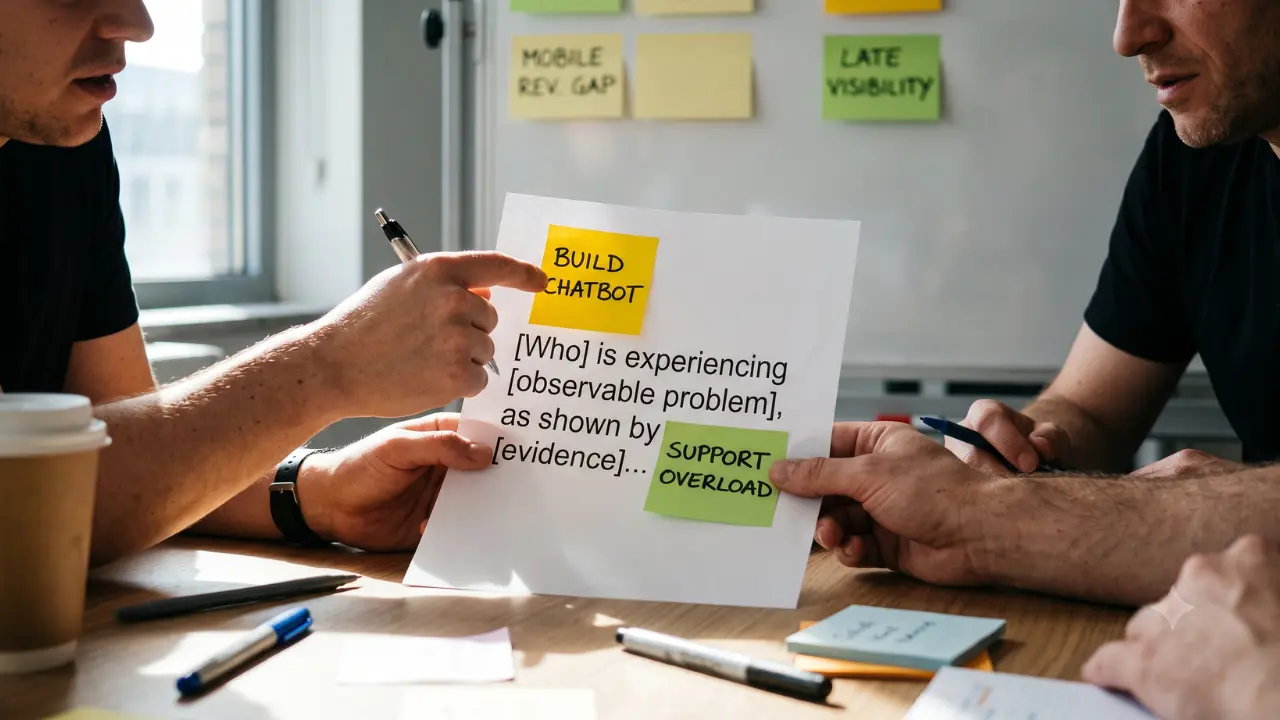
- A request like "we need a loyalty program" is a solution in disguise. It hides the real problem and closes off every other option.
- Reframing it as a problem statement exposes the assumption you need to test and gives you a measurable definition of success.
- Below: a fill-in template, a free problem statement builder, and 10 worked examples, each with four alternative solutions.
Most product backlogs are full of answers to questions nobody wrote down. Someone senior says "we need a chatbot," the request becomes a Product Backlog item, and three Sprints later the team ships something that was never tied to a measurable problem. Formulating work as problems to solve is the simplest habit that breaks this cycle.
Solution Format vs Problem Format
Every piece of work arrives in one of two shapes. The solution format tells you what to build. The problem format tells you what is going wrong, for whom, and why it matters. Both might describe the same situation, but they lead teams to very different places.
| Solution format | Problem format | |
|---|---|---|
| Sounds like | "We need to launch a targeted ad campaign." | "Acquisition costs are rising and eating into profitability." |
| Option space | One answer, already chosen | Many possible answers to compare |
| Driven by | Opinion or seniority | Evidence and observation |
| Success means | "We shipped it" | "The problem measurably shrank" |
| Risk | Building the wrong thing efficiently | Spending a little time on discovery first |
Why Formulating Work as Problems Leads to Better Products
It opens the option space
A solution-framed request has already picked the answer. A problem statement invites the whole Scrum Team to propose alternatives, and the cheapest effective option is rarely the first one someone thought of. In the examples below, every problem has at least four credible solutions, and the originally requested one is often not the strongest.
It exposes the assumption you need to test
"Offer renewal discounts to improve retention" quietly assumes customers leave because of price. If they actually leave because they never got value from the product, discounts just reduce revenue from customers who would have stayed anyway. Writing the problem first makes that hidden assumption visible and testable.
It defines what "done" really means
When the work is "build a loyalty program," the finish line is shipping it. When the work is "engagement is declining and hurting retention," the finish line is a change in engagement and retention. That shift moves the conversation from output to outcome, which is exactly where the Product Owner's accountability for value sits.
It moves decisions from authority to evidence
A problem statement with evidence attached is much harder to override with "the CEO wants it." It gives Product Owners a respectful, factual way to say "let's check first," and it gives stakeholders a way to see their concern taken seriously without their specific solution being accepted by default.
Business Problem Statement Template
Use this five-part template. If you cannot fill in one of the slots, that gap is usually the first thing to go and find out.
- Who: a specific customer segment, user group or internal team, not "everyone."
- Observable problem: something you can see happening, described without naming a fix.
- Evidence: data, support tickets, interviews or observations that show the problem is real.
- Business impact: why it matters, in terms of revenue, cost, risk, satisfaction or time.
- Measurable outcome: the signal that will tell you the problem has shrunk.
How to Reframe a Solution into a Problem
When a request arrives in solution format, work through these questions in order with the person who raised it. You are not rejecting their idea. You are finding out what it is meant to fix.
- What happens if we do nothing? This surfaces the pain behind the request.
- Who feels that pain most? This narrows "customers" to a real group.
- How do we know it is happening? This separates evidence from belief.
- What does it cost us? This connects the problem to value and priority.
- What would tell us it is fixed? This gives you an outcome to measure instead of a feature to ship.
Try it: Problem Statement Builder
Fill in the five parts. The builder assembles your statement and flags wording that sneaks a solution back in.
10 Business Problem Statement Examples
Each example starts with a request as it typically arrives, reframes it as a problem, then lists four potential solutions. Notice how often the original request is just one option among several.
1. Customer acquisition cost
Solution format: We need to launch a targeted digital ad campaign to lower customer acquisition costs.
Problem format: Our customer acquisition efforts are not delivering expected results, leading to higher-than-anticipated costs and reduced profitability.
Potential solutions
- Optimize targeting using AI: analyze customer behavior with AI-driven tools and refine ad targeting for more cost-effective acquisition.
- Leverage partnerships: cross-promote with complementary businesses and share customer bases to reduce individual acquisition costs.
- Referral programs: reward existing customers for bringing in new ones, using word-of-mouth marketing.
- Experiment with content marketing: shift some spend from paid ads to organic growth through blogs and videos that attract customers naturally.
2. Declining customer engagement
Solution format: We should implement a loyalty program to improve customer engagement.
Problem format: We have observed a decline in customer engagement, which is negatively impacting retention rates and overall customer satisfaction.
Potential solutions
- Personalized communication: use data analytics to tailor messages and offers to customer behavior and preferences.
- Gamification: add points, challenges or rewards that encourage regular interaction with the product.
- Community building: create an online community where customers share ideas and engage directly with the brand.
- Customer experience audits: have teams or external experts walk the full customer journey to find friction points.
3. Inconsistent customer experience
Solution format: We need to invest in customer experience management software to ensure consistent customer interactions.
Problem format: Our customers are reporting inconsistent experiences across different touchpoints, resulting in decreased customer satisfaction and loyalty.
Potential solutions
- Unified customer data platform: aggregate customer data across touchpoints so every department sees the full picture.
- Mystery shopper programs: use testers to continuously monitor and report inconsistencies across channels.
- Cross-department workshops: bring sales, service and marketing together to design one seamless experience.
- Voice of the Customer initiatives: collect feedback at every stage and close the loop quickly on service issues.
4. Stagnant retention
Solution format: We should offer discounts to customers who renew their subscription to increase retention rates.
Problem format: Customer retention rates have stagnated, and we are struggling to maintain engagement, leading to a potential decline in long-term customer loyalty.
Potential solutions
- Predictive analytics: identify customers at risk of churning and intervene early with personalized offers or outreach.
- Loyalty-based membership: create tiers whose benefits grow with continued engagement.
- Surprise and delight: occasionally reward loyal customers with gifts or VIP treatment to build emotional connection.
- Customer advisory boards: involve customers in product decisions to deepen their relationship with the brand.

Practice This Live in the PPDV Class
Professional Product Discovery and Validation is a one-day, hands-on Scrum.org class where you reframe requests into problem statements, design low-cost experiments, and make investment decisions on evidence instead of opinion.
Explore PPDV Training5. Support overload
Solution format: We need an AI chatbot to handle customer support.
Problem format: Support ticket volume is growing faster than our support team, pushing first-response times beyond what customers tolerate and increasing complaints about slow help.
Potential solutions
- Fix the top contact drivers: analyze the most frequent ticket reasons and remove their root causes in the product.
- Self-service help: publish searchable answers for the questions customers ask most.
- AI-assisted triage: let AI classify and draft replies while support agents review and send them.
- Proactive notifications: tell customers about order status, outages or delays before they have to ask.
6. Mobile revenue gap
Solution format: We should build a native mobile app.
Problem format: A growing share of visitors arrive on mobile, but they abandon checkout far more often than desktop users, so mobile traffic is not turning into revenue.
Potential solutions
- Mobile usability testing: watch five real users try to check out on their phones and note where they stall.
- Simplify mobile checkout: cut form fields and add one-tap payment options such as wallets and UPI.
- Progressive web app: deliver app-like speed and saved details without an app-store install.
- A/B test the flow: compare a shortened checkout against the current one before redesigning anything else.
7. Late visibility of delivery risk
Solution format: We need a new executive dashboard.
Problem format: Leaders learn about delivery risks late, often at the release review, which leaves too little time to adjust scope, budget or customer expectations.
Potential solutions
- Stakeholder-inclusive Sprint Reviews: invite leaders to inspect the working Increment every Sprint instead of reading status reports.
- Flow metrics: track cycle time and work item age so risks show up as trends, not surprises.
- Evidence-Based Management: review Key Value Areas regularly so decisions rest on value, not activity.
- Product Goal check-ins: review progress toward the Product Goal on a fixed cadence with decision-makers.
8. Missed delivery forecasts
Solution format: We need to hire five more developers to hit the deadline.
Problem format: We consistently miss our delivery forecasts, which erodes stakeholder trust and delays revenue from committed releases.
Potential solutions
- Limit work in progress: finish fewer items at a time so work flows instead of piling up half-done.
- Slice the scope: split large items so the most valuable part can ship first.
- Remove dependencies: reduce handoffs between teams that stall items for days.
- Find the real bottleneck: measure flow to see whether the constraint is coding, testing, review or approvals.
9. Slow, risky releases
Solution format: We should migrate our system to microservices.
Problem format: Releases take weeks, and small changes often break unrelated parts of the system, so teams avoid shipping and customer fixes wait.
Potential solutions
- Automated tests on hotspots: add test coverage where changes happen most and breakages hurt most.
- Continuous integration and delivery: automate build and deployment so releases become routine.
- Modularize incrementally: separate the most tangled area first rather than rewriting everything.
- Feature flags: decouple deploying code from releasing features to reduce release risk.
10. Quality slipping as AI speeds up coding
Solution format: We need an AI agent to write all our unit tests.
Problem format: Since adopting AI coding assistants, code volume has jumped, but defects escaping to production are rising because review and verification capacity has not kept pace.
Potential solutions
- Make verification explicit: strengthen the Definition of Done so AI-generated code meets the same quality bar as human code.
- Limit review queues: cap open pull requests so verification keeps pace with generation.
- Risk-based testing: focus human review on the areas where defects cost the most.
- Human-owned acceptance criteria: let AI help generate tests, but keep people accountable for what "correct" means.
Common Mistakes When Writing Problem Statements
- A solution in disguise: "Customers lack a loyalty program" is still a solution. Ask what happens because they lack it.
- Too vague to act on: "Customers are unhappy" needs a who, a what and some evidence before anyone can test it.
- No evidence: a problem nobody has observed is a hypothesis. That is fine, but label it as one and validate it first.
- Blaming users: "Users don't read the instructions" describes a design problem as a user failing.
- Several problems at once: if the statement needs "and" three times, split it and prioritize.
From Problem Statement to Experiment
A good problem statement is the start of discovery, not the end. The next step is to pick the most promising potential solution, name the riskiest assumption behind it, and design the smallest, cheapest test that would prove that assumption wrong. Only when evidence supports it does the team commit a full Sprint or more.
This is the core of the Professional Product Discovery and Validation (PPDV) class, where you practice reframing, experiment design and evidence-based investment decisions on a realistic product case.
Frequently Asked Questions
What is a business problem statement?
A business problem statement is a short description of an observable problem, who experiences it, the evidence that it exists, and the impact it has on the business. It deliberately leaves the solution open so the team can explore more than one way to solve it.
What is the difference between a solution format and a problem format?
A solution format states what to build, such as "We need to launch a loyalty program." A problem format states what is going wrong and why it matters, such as "Customer engagement is declining and hurting retention." The problem format keeps the option space open and makes the underlying assumption testable.
How long should a problem statement be?
One to three sentences is enough. It should name who is affected, what is observably going wrong, the evidence, the business impact, and how you will know it is solved. If it needs a full page, you are probably describing several problems at once.
Who should write the problem statement in a Scrum Team?
The Product Owner is accountable for maximizing value and usually leads the framing, but the best problem statements are shaped together with Developers and stakeholders. Writing it collaboratively surfaces assumptions early and gives the whole team a shared definition of success.
What do you do after writing a problem statement?
List several potential solutions, identify the riskiest assumption behind the most promising one, and run a small, cheap experiment to gather evidence before committing a full team to building it. This is the core skill practiced in the Professional Product Discovery and Validation (PPDV) class.
Looking for more frameworks? Browse the full collection of Product Management Templates, including product vision and user story templates.